Sumathy Sivamohan
In the short span of two or three days, Cyclone Ditwah, has caused a disaster of unprecedented proportions in our midst. Lashing away at almost the entirety of the country, it has broken through the ramparts of centuries old structures and eroded into areas, once considered safe and secure.
The rains may have passed us by. The waters will recede, shops will reopen, water will be in our taps, and we can resume the daily grind of life. But it will not be the same anymore; it should not be. It should not be business as usual for any of us, nor for the government. Within the past few years, Sri Lankan communities have found themselves in the middle of a crisis after crisis, both natural and man-made, but always made acute by the myopic policies of successive governments, and fuelled by the deeply hierarchical, gendered and ethnicised divides that exist within our societies. The need of the hour for the government today is to reassess its policies and rethink the directions the country, as a whole, has been pushed into.
Neoliberal disaster
In the aftermath of the devastation caused by the natural disaster, fundamental questions have been raised about our existence. Our disaster is, in whole or in part, the result of a badly and cruelly managed environment of the planet. Questions have been raised about the nature of our economy. We need to rethink the way land is used. Livelihoods may have to be built anew, promoting people’s welfare, and by deveoloping a policy on climate change. Mega construction projects is a major culprit as commentators have noted. Landslides in the upcountry are not merely a result of Ditwah lashing at our shores and hills, but are far more structural and points to centuries of mismanagement of land. (https://island.lk/weather-disasters-sri-lanka-flooded-by-policy-blunders-weak-enforcement-and-environmental-crime-climate-expert/). It is also about the way people have been shunted into lands, voluntarily or involuntarily, that are precarious, in their pursuit of a viable livelihood, within the limited opportunities available to them.
Neo liberal policies that demand unfettered land appropriation and built on the premise of economic growth at any expense, leading to growing rural-urban divides, need to be scrutinised for their short and long term consequences. And it is not that any of these economic drives have brought any measure of relief and rejuvenation of the economy. We have been under the tyrannical hold of the IMF, camouflaged as aid and recovery, but sinking us deeper into the debt trap. In October 2025, Ahilan Kadirgamar writes, that the IMF programme by the end of 2027, “will set up Sri Lanka for the next crisis.” He also lambasts the Central Bank and the government’s fiscal policy for their punishing interest rates in the context of disinflation and rising poverty levels. We have had to devalue the rupee last month, and continue to rely on the workforce of domestic workers in West Asia as the major source of foreign exchange. The government’s negotiations with the IMF have focused largely on relief and infrastructure rebuilding, despite calls from civil society, demanding debt justice.
The government has unabashedly repledged its support for the big business class. The cruelest cut of them all is the appointment of a set of high level corporate personalities to the post-disaster recovery committee, with the grand name, “Rebuilding Sri Lanka.” The message is loud and clear, and is clearly a slap in the face of the working people of the country, whose needs run counter to the excessive greed of extractive corporate freeloaders. Economic growth has to be understood in terms that are radically different from what we have been forced to think of it as, till now. For instance, instead of investment for high profits, and the business of buy and sell in the market, rechannel investment and labour into overall welfare. Even catch phrases like sustainable development have missed their mark. We need to think of the economy more holistically and see it as the sustainability of life, livelihood and the wellbeing of the planet.
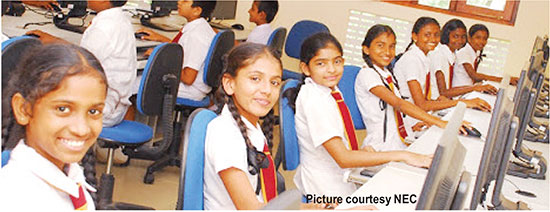
The disaster has brought on an urgency for rethinking our policies. One of the areas where this is critical is education. There are two fundamental challenges facing education: Budget allocation and priorities. In an address at a gathering of the Chamber of Commerce, on 02 December, speaking on rebuilding efforts, the Prime Minister and Minister of Education Dr. Harini Amarasuriya restated her commitment to the budget that has been passed, a budget that has a meagre 2.4% of the GDP allocated for education. This allocation for education comes in a year that educational reforms are being rolled out, when heavy expenses will likely be incurred. In the aftermath of the disaster, this has become more urgent than ever.
Reforms in Education
The Government has announced a set of amendments to educational policy and implementation, with little warning and almost no consultation with the public, found in the document, Transforming General Education in Sri Lanka 2025 published by the Ministry of Education. Though hailed as transformative by the Prime Minister (https://www.news.lk/current-affairs/in-the-prevailing-situation-it-is-necessary-to-act-strategically-while-creating-the-proper-investments-ensuring-that-actions-are-discharged-on-proper-policies-pm), the policy is no more than a regurgitation of what is already there, made worse. There are a few welcome moves, like the importance placed on vocational training.Here,I want to raise three points relating to vital areas of the curriculum that are of concern: 1) streamlining at an early age; relatedly 2) prioritising and privileging what is seen as STEM education; and 3) introducing a credit-based modular education.
1. A study of the policy document will demonstrate very clearly that streamlining begins with Junior Secondary Education via a career interest test, that encourages students to pursue a particular stream in higher studies. Further Learning Modules at both “Junior Secondary Education” and “Senior Secondary Education Phase I,” entrench this tendency. Psychometric testing, that furthers this goal, as already written about in our column (https://kuppicollective.lk/psychometrics-and-the-curriculum-for-general-education/) points to the bizarre.
2. The kernel of the curriculum of the qualifying examination of Senior Secondary Education Phase I, has five mandatory subjects, including First Language, Math, and Science. There is no mandatory social science or humanities related subject. One can choose two subjects from a set of electives that has history and geography as separate subjects, but a Humanities/Social Science subject is not in the list of mandatory subjects. .
3. A credit-based, modular education: Even in universities, at the level of an advanced study of a discipline, many of us are struggling with module-based education. The credit system promotes a fragmented learning process, where, depth is sacrificed for quick learning, evaluated numerically, in credit values.
Units of learning, assessed, piece meal, are emphasised over fundamentals and the detailing of fundamentals. Introducing a module based curriculum in secondary education can have an adverse impact on developing the capacity of a student to learn a subject in a sustained manner at deeper levels.
Education wise, and pedagogically, we need to be concerned about rigidly compartmentalising science oriented, including technological subjects, separately from Humanities and Social Studies. This cleavage is what has led to the idea of calling science related subjects, STEM, automatically devaluing humanities and social sciences. Ironically, universities, today, have attempted, in some instances, to mix both streams in their curriculums, but with little success; for the overall paradigm of education has been less about educational goals and pedagogical imperatives, than about technocratic priorities, namely, compartmentalisation, fragmentation, and piecemeal consumerism. A holistic response to development needs to rethink such priorities, categorisations and specialisations. A social and sociological approach has to be built into all our educational and development programmes.
National Disasters and Rebuilding Community
In the aftermath of the disaster, the role of education has to be rethought radically. We need a curriculum that is not trapped in the dichotomy of STEM and Humanities, and be overly streamlined and fragmented. The introduction of climate change as a discipline, or attention to environmental destruction cannot be a STEM subject, a Social Science/Humanities subject or even a blend of the two. It is about the vision of an economic-cum-educational policy that sees the environment and the economy as a function of the welfare of the people. Educational reforms must be built on those fundamentals and not on real or imagined short term goals, promoted at the economic end by neo liberal policies and the profiteering capitalist class.
As I write this, the sky brightens with its first streaks of light, after days of incessant rain and gloom, bringing hope into our hearts, and some cheer into the hearts of those hundreds of thousands of massively affected people, anxiously waiting for a change in the weather every second of their lives. The sense of hope that allows us to forge ahead is collective and social. The response by Lankan communities, to the disaster, has been tremendously heartwarming, infusing hope into what still is a situation without hope for many. This spirit of collective endeavour holds the promise for what should be the foundation for recovery. People’s demands and needs should shape the re-envisioning of policy, particularly in the vital areas of education and economy.