Hasini Lecamwasam
Brain drain in Sri Lanka is at an all-time high. The latest Human Flight and Brain Drain Index for 2024 shows that we are 16th of 175 countries on this count, and first in South Asia. That this is a crisis goes without saying. Brain drain affects all sectors, and is a huge strain on the resources of a developing country. Particularly in Sri Lanka, where considerable public investment is made in the moulding of professionals through the system of free education, this amounts to transferring the resources of poorer countries to richer ones with top migration destinations. It is therefore important to consider the push and pull factors behind skilled outmigration specifically from the public university system of Sri Lanka, a key focus of the Kuppi column.
From frustration to exit
Several bitter realities in our crumbling public university system act as push factors in the migration decisions of academics. Many essays on this column have, over several years, attempted to highlight numerous aspects of this erosion. Perhaps primary among them is the lack of adequate funding, which has debilitating ramifications for the system: very little investment is made in the up-keep of infrastructure (and even less in its expansion), resulting in serious constraints in accommodating growing batches of students and the wellbeing of the staff (particularly in regional universities); research funding is negligible, severely curtailing academics’ ability to effectively discharge their primary duty of teaching which should ideally be informed by their research (and the research of others, access to which is also unfortunately mediated by funding); a funding crunch also means a slash in (or greater constraints on) recruitments, increasing the workloads of academics currently in service and eating into the quality of their teaching and research.
What recruitments are done, frustrate those with any faith in merit. As many of our interventions in this column have shown, recruitment processes are characterised by archaic selection criteria that place very little weight on a candidate’s postgraduate growth and the advantages of interdisciplinary training. Added to this is the general preference for ‘culturally compliant’ candidates who would not rock the boat too much. The combined effect is that those with the capacity and spirit to try out innovations in education are discouraged from joining or staying on in the public university system. Some, or many, of them may instead seek appointments abroad.
A thread that binds all of these problems together is pervasive hierarchy which, again, many interventions on this column have sought to highlight. It is the interest in preserving hierarchy that leads to the preference for alumni in recruitment processes. Hierarchy within universities can be particularly frustrating for younger faculty and women, who typically have to bear the brunt of the workload of their senior, often male, colleagues. In a context of funding, and therefore recruitment, restrictions, this translates into a disproportionate burden being placed on junior (usually female) faculty, seriously hindering their prospects of growing into successful academics due to the time constraints within which they have to operate. Junior academics, therefore, are more likely to look to educational institutions abroad for what they hope would be a different work culture that respects them more.
Ideological ruses
On top of these structural frustrations are also the workings of neoliberal ideology. For one, the nature of relations between the global metropole and peripheral countries like Sri Lanka largely dictates what is desirable and what is not. The apparent lifestyles of Western countries – from food to clothing, housing, appliances, and so on – have continued to lure people from the periphery with the promise of a ‘better’ life, alongside better career advancement opportunities. This of course masks much of the struggle that goes on behind the scenes to survive in Western societies. For instance, in most cases highly attractive public infrastructure such as roads, public transport, clean air, quality control of food, and so on belie the astronomical privatised costs of healthcare and education. Health insurance is usually mandatory and steep in most high-income settings, while even subsidised education (for which eligibility criteria are strict) creates a serious dent in household earnings. Of course, the happy images of glossy trams and gleeful international travelers don’t convey this.
A second ideological ruse is the myth of greater opportunities and recognition abroad. While there is no denying that local skilled sectors – be it higher education, health, civil service, or private white-collar positions – are replete with issues that inhibit merit-based professional advancement, the notion that things are fundamentally different in Western countries stems from an uninformed optimism. As is now increasingly known and discussed, Western labour markets are notoriously racialised, and equivalent skills are rarely treated as such. Instead, it is usually demanded that skilled migrants clear certain formal examinations in their host countries. In fields like medicine, this is followed by an interview that may also be racially prejudiced. Once these initial steps are cleared, remuneration reverts to square one irrespective of experience accumulated abroad, not to mention the many subtle aggressions, rejections, and trials one has to go through in the negotiation of everyday life. In the many cases where professional qualifications are used as leverage for a move abroad, sights are set on a better future for one’s children, which again is informed by the misplaced faith in greater opportunities and a lack of awareness of the factors outlined above. Needless to say that in the global swing to the Right, things have become even more challenging. In such a context, considering the few rare cases where skilled migrants live extremely comfortable lives as the norm becomes a dangerous misconception.
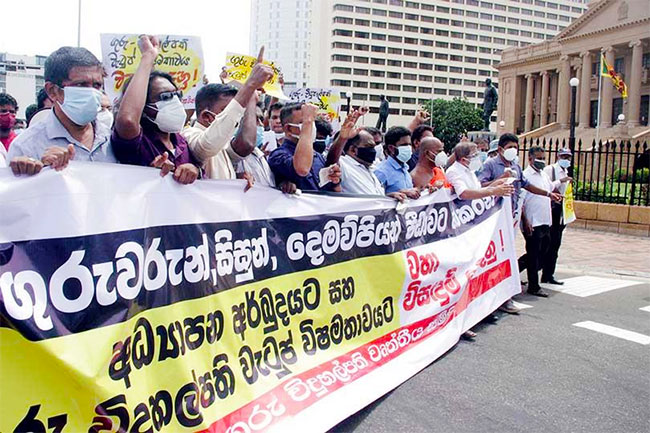
The two ideological pull factors mentioned above are complemented by a push factor, which has to do with a highly classed understanding of what a white-collar professional is due in their society. Many of these aspirations are clearly articulated in academic trade union action demanding separate quotas for school entry, increased fuel allowances, winning back the presently stalled vehicle permit scheme, salary hikes, and so on. While working people have every right to agitate for better material conditions, insofar as it remains unconnected to a broader movement for improving the conditions of the lot of the working class, it remains self-serving and very much within the class logic of capitalist society. Since these demands are articulated as a means of maintaining distinction, it is clear that they are not envisaged as part of a class movement. The frustration of not having these needs for distinction satisfied may push some to seek greener pastures abroad at least financially (perhaps as a means of social mobility based on it), only to be disappointed on most occasions.
What is to be done?
Addressing the systemic push factors listed above requires, first and foremost, greater allocations for free public higher education. This would immediately translate into more recruitments and less work per academic, and better research and teaching in the long haul. An increase in funding would also ideally lead to greater infrastructural investments, especially including improving the living conditions of those who work in regional universities amid untold hardships. Next, fairer, more creative, and therefore more effective recruitment policies are badly needed to attract talented individuals to university positions. Rather than carving out a ‘special category’ for academics to achieve this purpose, which is informed by a classed logic, this needs to be done through fundamental reforms in recruitment processes. Third, a persistent attack on the entrenched hierarchy within universities through internal reform is much called for. Reforming recruitment practices will go a long way towards addressing this. Measures should also be taken to introduce more stringent policies against SGBV (not to mention ragging, even though it is not directly connected to brain drain). Such measures would create a safer, fairer, and more attractive workplace, which would give more reasons for people to stay. On top of greater allocations, we also need a transformation of our aspirations themselves if this situation is to change. That necessitates a kind of education capable of questioning the ‘paradise’ conception of Western societies, and lays bare their colonial material and ideological dimensions, in both their historical and contemporary manifestations. These colonial understandings of the ‘good life’, moreover, have devastating ecological implications for the planet, not to mention social justice. An education with the ability to transform this mindset would hopefully prove to be more than a mere path to social mobility, rather being a tool of social emancipation that renders mobility moot.