Shamala Kumar
Through a review of the history of national policy making on university education, this first of a two-part Kuppi Talk demonstrates the persistent lack of a strong and systematically formulated policy for Sri Lanka’s university system.
PART I
Free education and the birth of a free country
“We contemplate generally that the cost of education from the kindergarten up to and including the University shall be a charge on the funds of the State…”.
Kannangara, 1943
The universal free education policy (1945) was the country’s post-colonial gift to our future selves. Granted, the policy was neither completely free (private tuition was allowed) nor universally applicable (Malaiyah Tamil communities were left out), it provided an ideological basis, a vision, and a mechanism through which general education could support the democratic aspirations of the fledgling nation. The policy was born from the daring to imagine a radically different society through transforming education, shaped by public dialogue, extensive debate, immense struggle, and a controversial commitment to fully fund the country’s education system.
“Sir, how much nobler – when we shall be able to say that we found education dear and left it cheap, that we found it a sealed book and left it an open letter, we found it the patrimony of the rich and left it the inheritance of the poor”
(Kannangara as quoted in Hansard 1944, 946; see Kalugalagedara & Kaushalya, 2017)
Although weakened substantially over time, the policy remains embedded in our nation’s consciousness; so much so that overtures to overturn free education, including at the higher education level, have been described as “political suicide.” While free education has remained for eight decades, fiercely guarded by the public, governments have made small, seemingly innocuous changes that have gradually diluted its scope.
Nowhere has the principle of free education taken a greater hit than in university education. Successive governments have weakened it through systemic underfunding, introducing fee-levying programmes and income-generating schemes in state institutions, and establishing private higher educational institutions.
University education and the free education policy
The free education policy significantly transformed university education. The transformation came from many quarters. For instance, the number eligible for higher education suddenly expanded. Consider the qualitative shift when just a few decades earlier, in 1901, only about 25% of children aged 5–14 were enrolled in formal education. By 1950, this had risen to about 54% and then continued to rise rapidly. As more became eligible for university, they could now also afford it because education was free. Furthermore, because it was envisioned to be bilingual, the huge majority who had previously studied in the vernacular school system, and had been left out because of language barriers, were now able to access higher education.
The policy was, however, quite murky about how these transformations were to occur. Such seismic shifts must have made envisioning the sector’s future difficult. Yet, even by the late 1940s, when the policy was in place and students were attending school in unprecedented numbers, there is little evidence of any concerted effort to systematically address the needs of those graduating with post-secondary qualifications. By 1950, five years after education had been made free, the state should have been able to anticipate the challenges arising as growing numbers of students moved through the general education system. The policy had not, however, anticipate how free education would transform higher education. Nor, once it was in place, was there any concerted attempt to develop a strategy to address these effects.
Thus, when the University had to adapt in the 1950s and 1960s, as a new type of aspirant for higher education emerged — one that had studied in Sinhala or Tamil, came from rural backgrounds, and held more democratic understandings of education — the system was unprepared. From then onwards, we have arguably done little more than make incremental policy changes that narrowly addressed problems that aligned with respective governments’, their allies’, or donors’ expectations of education.
The University of Ceylon
The conception of the University of Ceylon predates the policy on free education. While general education had C.W.W. Kannangara, university education had Ivor Jennings. Jennings was, in fact, opposed to the free education policy. He was tasked in 1929 by the colonial government to first head the newly formed University College of Ceylon, the local affiliate of the University of London, and then to lead the formation of the University of Ceylon.
At the time, anticolonial sentiments were gaining ground and, along with growing pressure to expand access to general education, calls for a national university also grew. Unlike the University College of Ceylon, which prepared students for London examinations, a national university was to give voice to local histories, arts and culture, and provide solutions to local problems. The University of Ceylon was thus carefully planned to reflect these sentiments, even in its location and architecture. It should be noted, however, that the University remained faithful to British conceptions of knowledge and higher learning. In fact, Jennings explicitly referred to the Oxbridge model as his inspiration. The University of Ceylon was therefore very much a colonial institution.
It was also unapologetically elite. The University of Ceylon was designed to create a select stratum of the country, perhaps a nationally conscious intelligentsia, who were to serve an independent nation state.
Politics and higher education
Jennings’ conception of the university was also explicitly removed from political control. Great pain was taken in the 1942 University of Ceylon Ordinance to shield the University from interference. However, from its inception, it was anything but unaffected by political influence. Jennings had close ties to Prime Minister D. S. Senanayake, and therefore formal “interference” was unnecessary. When relations were strained, as between the next Vice Chancellor, Nicholas Attygalle, and the then ruling party, SLFP, political pressures on university governance became evident, as is demonstrated with the conversion of Vidyodaya and Vidyalankara Pirivenas into universities in the 1950s.
Prior to the 1950s, admissions to the University of Ceylon were based on the seats available at the University and on the number of graduates the country needed. Accordingly, it catered to a small number of students. The entrance examination was held in English, with some subjects such as Medicine requiring an interview, which meant that those without fluency in English would not be admitted. When presented with the rising tide of students the free education policy would bring, many of them educated in Sinhala and Tamil, the University resisted, considering the medium instruction. Of course, the SLFP was able to intervene, having decisively won elections in 1956 using nationalist politics and being immensely popular at the time with the Sinhala majority. In response to the University’s resistance to accommodating Sinhala and Tamil medium students, Vidyodaya and Vidyalankara were recognised as universities in 1958-59. At that time, these newly formed universities taught only in the Sinhala medium. This meant, of course, that students who had studied in Tamil medium had no corresponding new institutional space offered to them. This asymmetry was nevertheless consistent with the politics of the period, coming shortly after the Official Language Act of 1956, which made Sinhala the sole official language of the country.
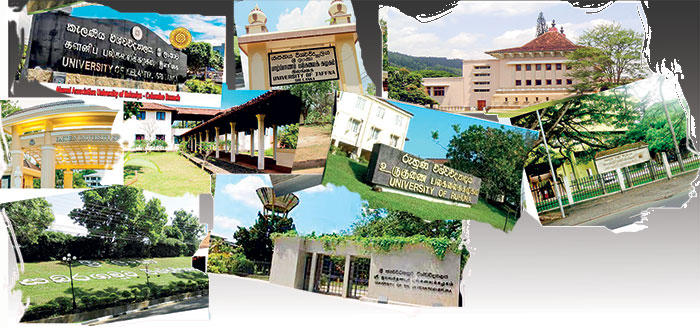
Over the years, the university system has expanded through the establishment of new campuses and universities into the state university system. From the 1960s onwards, culminating with the establishment of Uva Wellassa University and the University of the Visual and Performing Arts in 2005, it expanded to 17 institutions. Along the way, the Universities Act was passed (1978), bringing most universities under its purview. Amendments to the Act in 1995 legally recognised non-state higher education institutions, of which around 30 have such recognition today. Furthermore, several other institutions have been established outside the Act through separate legislation, including Kotelawala Defence University and the Ocean University of Sri Lanka. Apart these institutions, a largely unregulated higher education sector with transnational inputs operates as business enterprises. The legal provisions allowing these different forms of higher education to emerge have, over time, been shaped primarily through ad hoc decisions, often championed by the ruling political party of the time.
Over the eight decades since the inception of free education, consideration of what we as a nation truly want from a free higher education system and how we might achieve it has been absent. This absence has allowed ad hoc decisions to be made. A lack of policy indicates a lack of transparency, meaning that the policy thrust of successive governments has not been subjected to the public scrutiny one would expect in a democratic country. It has also left us with a system of free higher education without a higher education policy and in dire need of reform.