Mahendran Thiruvarangan
It is difficult to imagine a university without its physical infrastructure. The classrooms, laboratories, libraries, auditoriums, board rooms, study halls, halls of residence, parking space, and sanitary facilities are all essential parts of the built infrastructure of a university. For education to happen in a meaningful, inclusive and democratic manner, these spaces are essential, should be maintained properly and upgraded and expanded based on needs. However, the state university system in Sri Lanka today reveals a disappointing situation when it comes to physical infrastructure.
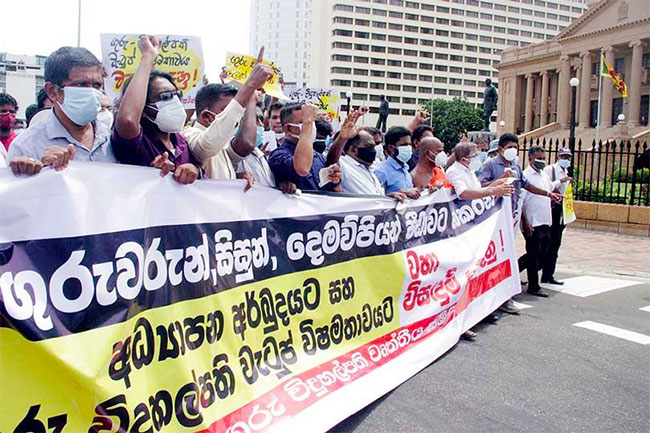
Take for example the Faculty of Arts, University of Jaffna where I teach. The classrooms are either inadequate or under-sized to conduct all the courses included in the academic programs offered by the Faculty. When student numbers increase, we conduct classes in auditoriums which are meant for public meetings and cultural programs. Due to the shortage of classrooms, classes take place in our offices and sometimes via Zoom even under normal circumstances. The hostel facilities available for our undergraduates are woefully inadequate. As a result, the students are asked to find private boarding places when they move to their second and third years. The sanitary facilities require better maintenance. Talking to colleagues at other universities in the country, I realize these issues are not specific to the University of Jaffna or its Faculty of Arts. Though new buildings and hostels have come up at some universities and funding for disability inclusion has increased under the current government, the general picture looks far from satisfactory. We saw university teachers and students demand fervently for increased and better infrastructure at the protests and rallies they conducted recently.
The primary reason for the infrastructure crisis faced by our universities today is lack of state funding for education. Although many, including the current Minister of Education, once demanded that 6% of the GDP be allocated to education, the materialization of this demand remains a distant dream even under a supposedly left-leaning government. The crux of the problem is the neoliberal logic that informs Sri Lanka’s economic decisions. The IMF programs that Sri Lanka relied on for economic revival have made the political establishment and authorities who make decisions concerning education believe that increased funding on social goods like education is undesirable and privatization the way-forward. The austerity push that we see today under the current IMF-driven Extended Fund Facility arrangement leaves no room for efforts to rejuvenate our education system including its physical infrastructure. As a result, the buildings at our universities are allowed to deteriorate and students are pushed out of hostels and forced to pay exorbitant rents.
The infrastructure crisis has been compounded by the rapid increase in admission of students to the state universities in the past few decades. While expansion of free education is an important and democratizing move, it cannot be done without a simultaneous increase in physical and human resources. The country’s free education system cannot be democratized through populist measures that do not pay sufficient attention to the availability of resources. The Ministry of Education and the University Grants Commission should first engage in proper deliberations and planning along with university administrations about increasing student intake and expansion of infrastructure. These consultative processes cannot be done for namesake but should be genuinely participatory and democratic. What we see today is that University administrators are either forced to comply with decisions made at the top with regard to admissions or they choose not to express their views openly at meetings since their opinions may displease authorities in the UGC or the ministry. The burden of accommodating the increasing number of students fall on the universities and the academics. This results in overpopulated classrooms and an unhealthy educational environment.
Another reason for the infrastructure crisis that we face today is thoughtless academic and curriculum planning on the part of universities and faculties. To create a name for themselves or score points for their promotion, university academics sometimes rush to create new academic programs. The World Bank and other donor agencies push universities to offer too many superficial courses in soft skills without taking into consideration the physical infrastructure and human resources available at the institution. Our universities readily embrace these ill-conceived proposals without assessing their usefulness to the students and the wider community and whether they have the necessary resources to implement them. Our curriculum committees, Faculty Boards and Senates fail to understand that the curriculum we teach cannot exist in isolation of the material conditions of the university and the availability of finances and resources. As a way forward, we must bring in the question of infrastructure as a central discussion point in planning, prioritizing and revising our academic programs and courses.
As observed by many writers in the previous editions of Kuppi Talk, universities are hierarchized spaces. There are hierarchies of disciplines and hierarchies of social relations that appear along lines of gender, ethnicity and (dis)ability. In planning and refurbishing physical infrastructure, a common tendency is observed across our system: prioritizing science and technology subjects over the humanities and social sciences. Whether it is the government or the UGC or administrators of our universities, everyone seems to think that when it comes to financial allocations for infrastructure facilities, laboratories and technical equipment should top the list. The fact that Faculties of Humanities and Social Sciences accommodate the largest numbers of students does not appear as a factor worthy of consideration in their deliberations. That these faculties too need adequate space for teaching and learning, academic conversations and cultural performances which are integral to their curriculum does not occur to decision makers.
Similarly, when decisions concerning physical infrastructure development are made, the needs of female students and female academics, especially sanitary facilities that are essential for them, are not taken into consideration seriously. Decision-making is oblivious to gender as a category that plays a key role in shaping our experience of the university infrastructure. The physical spaces that we use for teaching and learning should be inclusive towards students with disabilities as well. There should be adequate and appropriate learning equipment that can support the education of such students. In the universities in the North-East, students come in large numbers from war-affected communities. A significant number of students with war-related disabilities are accommodated at these universities. The current allocations to support such students should be increased.
Our universities sometimes prioritize the outward appearance of the university over the actual educational and extra-curricular needs of the students in planning physical infrastructure. Recently, when a state university celebrated a key anniversary, the entrance to the university was refurbished and decorated in a grand manner. When this happened, one student posted a critical question on social media about the importance given to the front entrance and the simultaneous negligence that classrooms had suffered in the past few years. There are students and teachers who have time and again registered their discontent over the infrastructure situation at their universities. However, their voices have had little impact on actual decision making.
The state, the Ministry of Education, the University Grants Commission and the administrations of our universities and we, academics, must take responsibility for the crisis our universities are facing today. Our reliance on neoliberal (non) solutions, negligence and shortsightedness have all contributed to this situation. Governments and university administrations change but the grip of neoliberalism and misgovernance never seem to leave us. To change this situation, we have to first prioritize education as an important social good and a democratic and democratizing process that needs to be supported by the state. This support should include increased spending on the physical infrastructure of our educational institutions. Decisions concerning infrastructure planning, development and refurbishment should happen in a democratic manner through deliberative processes where the voices of the students and teachers are heard with seriousness and sincerity. We need to see the changes we propose to infrastructure as a democratizing move. Such changes should aim to dismantle the hierarchies that reproduce universities as unequal spaces, and create the university as a space of inclusion.